An excerpt from the forthcoming book — The Flow Within
Improving Women's Health Through Manual Lymphatic Drainage by Li Ye "Rita" Rawlings, Female Owner and Chief Therapist at Red Cupping Clinic, Redmond, Washington, USA.
Menopause does not arrive the way we expect it to. It doesn't sweep in with clear-cut signs or a dramatic announcement; instead, it drifts into a woman's life quietly — first as a whisper, then a pattern, then a new rhythm. A heaviness in the legs after a long day. Puffiness around the eyes that lingers longer each morning. A body that feels somehow fuller, slower, more reactive to stress and salt and sleepless nights. For many women, the changes are subtle yet undeniable: "I feel swollen," "I feel stuck," "I don't feel like myself."
Not every woman experiences all the symptoms, but if you have any one or more of the following on a regular basis, you may be entering Menopause: Mood swings, depression, difficulty sleeping, irritability, hot flashes, headaches, difficulty concentrating, loss of libido (or increase of libido), joint and other body pain.

The many faces of menopause
Culturally, we talk about menopause almost exclusively through the language of hormones — estrogen, progesterone, hot flashes, night sweats. But behind the scenes, another system is deeply affected by this transition. It is a system that clears, filters, balances, and regulates the very fluid that surrounds our cells. It is the system that governs puffiness, swelling, breast tenderness, tension, and those mysterious sensations women describe as "congestion" or "tightness."
This system is the lymphatic system, and for many women, supporting its flow may be one of the most overlooked keys to navigating menopause with grace and ease.
Why the Lymphatic System Matters More Than We Realize
The lymphatic system is the body's quiet maintenance crew: a network of vessels and nodes that moves fluid, removes cellular waste, supports immunity, and maintains the delicate balance between blood circulation and interstitial fluid. When it functions well, you don't notice it. But when it slows — because of hormonal change, stress, inactivity, inflammation, or aging — its effects become unmistakable.
During peri- and post-menopause, estrogen declines significantly. Estrogen has a profound influence on vascular tone, collagen stability, and fluid regulation. Without it, women are more susceptible to fluid retention, tissue swelling, and changes in the elasticity of lymphatic vessels themselves. Many women instinctively describe this shift as "everything feeling heavier" or "like I'm holding onto water I can't get rid of."
This isn't imagination — it's physiology.
Medical literature increasingly recognizes that menopause brings not only hormonal transitions but vascular and lymphatic changes as well. The combination can lead to:
- Puffiness in the face
- Swollen eyelids or under-eye bags
- Breast tenderness or chest wall pressure
- Aching, heavy legs
- Increased fluid retention
- Digestive sluggishness and abdominal fullness
- Tension in the neck, shoulders, and upper back
- Sleep disturbances related to discomfort or fluid shifts
And while hormone therapy remains the most evidence-based medical intervention for many menopause symptoms, there is a growing body of research showing that manual therapies — such as manual lymphatic drainage (MLD), cupping, and gua sha — can play a powerful supportive role.
What the Research Is Beginning to Show
Though the field is still evolving, several studies shed light on how hands-on therapies can support women during menopause.
A small but meaningful Japanese study followed women experiencing menopausal symptoms who received a single session of simplified manual lymph drainage. After treatment, they experienced measurable reductions in cortisol (a stress hormone) and DHEA, along with significant improvements in subjective symptoms. Participants often described a feeling of "lightness," especially in their legs.
Another randomized controlled trial from Turkey explored the use of cupping therapy in postmenopausal women. The results were compelling: women who received cupping therapy reported significant improvements in vasomotor symptoms (like hot flashes), physical discomfort, and even sexual well-being — all measured on a validated menopause-specific quality-of-life scale.
Meanwhile, gua sha has been tested extensively in studies on chronic neck and back pain. Results consistently show reduced pain intensity, improved circulation, and deeper relaxation responses. For menopausal women — many of whom experience increased muscular tension, headaches, or sleep disruption — those effects can be particularly meaningful.
None of these therapies "treat menopause." But they can support the body systems most disrupted by it, especially when those systems are ignored in traditional conversations about midlife health.
Enter the Red Cupping Clinic Flow Method
This is where practitioners like Li Ye "Rita" Rawlings offer something deeply valuable.
Rita is one of the top licensed specialists in manual lymphatic drainage on the West Coast with more than 25 years of experience treating customers with lymphatic massage, lymphatic cleansing, cupping and Gua Sha therapies. Over the years, she has guided hundreds of women through the physical and emotional terrain of peri- and post-menopause. Her approach — gentle, intuitive, and evidence-informed — focuses on restoring fluidity where the body has become stagnant.
In her treatment room, women discover something quietly revolutionary:
You can feel like yourself again when your body is given permission to flow.
What Women Often Present With
Rita sees common themes among her menopausal clients:
- Faces that appear puffier, especially around the jawline and under the eyes
- A sensation of "pressure" in the breasts, chest wall, and upper ribs
- A tight band across the neck and shoulders
- Aching behind the shoulder blades
- Swelling around the ankles or lower legs
- New or worsening headaches
- A feeling of "water weight" that exercise doesn't resolve
- Poor sleep due to discomfort, tension, or heat
These symptoms are not superficial. They reflect fluid trapped in tissues, congestion around lymph nodes, compromised microcirculation, and the stress-related tightening of fascia and musculature.
How Rita Approaches Menopause Through Flow
A typical menopause-focused session blends several techniques:
1. Manual Lymphatic Drainage (MLD)
Light, rhythmic strokes open the key drainage basins — neck, clavicles, axilla (armpits), abdomen, and groin. This creates pathways for fluid to return to the bloodstream, relieving congestion in the face, chest, and limbs.
2. Targeted Cupping
Cups placed along the upper back, shoulder girdle, and lateral chest wall help decompress fascia, increase microcirculation, and release the "iron bra" tension many women describe during menopause.
3. Gua Sha for Face, Neck, Jaw, and Chest
Using top of the line variable suction cupping machines, Red Cupping Clinic therapists move these cups gently across the face, neck, jaw line, chest and other major lymphatic node and drainage areas. This movement of the cups is called Gua Sha, and it softens hardened tissue, encourages blood flow, reduces swelling and releases muscular holding patterns that often worsen with stress or hormonal fluctuation.

Manual lymphatic drainage massage and Gua Sha cupping movement directions
4. Nervous-System Regulation
As lymphatic techniques stimulate the parasympathetic (rest-and-digest) response, women often report deeper breathing, improved sleep, and calmer moods — all crucial during hormonal transition.
The effect is cumulative but often noticeable immediately:
- Facial contours become more defined.
- Swelling decreases around the eyes.
- Breasts feel less tender, less full.
- Shoulders drop back into a natural position.
- Pain melts into warmth.
- Sleep deepens that night.
It is not dramatic; it is restorative.
Real Women, Real Outcomes
While every woman's experience is unique, the stories share a common thread: relief.
Two women (shown below) experienced significant reduction in face and eye puffiness. They saw immediate face lifting effect that lasted for weeks. Another shared that her chronic breast tenderness — once assumed to be inevitable — had faded completely after several weeks of consistent lymphatic work. All patients talked about how much lighter they felt and how their mood lifted once their body's lymphatic systems were back in working order.

Significant reduction in face and eye puffiness with lymphatic drainage
Patients experienced an immediate face lifting effect that lasted for weeks.
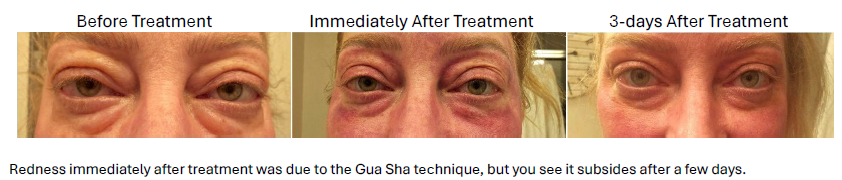
Lymphatic massage eye treatment — before and after
These are not medical cures. They are quality-of-life transformations. The kind women feel in their bones, their breath, and their ability to move through the world with more ease.
Menopause is not just a hormonal journey — it is a fluid journey. This truth is surprisingly absent from public conversation. We talk about hot flashes, mood swings, and bone density. But we don't talk about the way women feel swollen, sore, tight, and congested. We don't talk about lymphatic stagnation, slowed circulation, or the discomfort that rises from fluid trapped in the body's tissues.
References
Pınar, N., et al. (2020). The effect of wet-cupping therapy on menopause-specific quality of life: a randomized controlled trial. Complementary Therapies in Clinical Practice. https://www.sciencedirect.com/science/article/pii/S1521694226000070
We do not prescribe, diagnose, or treat any disease or medical condition.
The information contained in this article is for educational and informational purposes only and is not intended as health or medical advice. Always consult a physician or other qualified health provider regarding any questions you may have about a medical condition or health objectives.
Begin your own recovery
Book a session and feel the difference lymphatic care can make.